
Before I get started, let me apologize for how long it’s been since I recorded here. I’ve been rather busy, and I’m pretty excited about why: I just finished the first draft of my book, with a proposed title of “Perfect Love, Perfect Fear: How the Religion of Love Gave Me Fear As Its Tool.” It was many weeks of intense work, with deep dives into theology, psychology, sociology, and more, but I got it done, and I’m really happy with this draft. Now that I’m waiting for some good folks to take an advance read, I’ve got some down time to return to my blog and podcasts. So I’m back.
Let’s get to the content for today.
Twice in the last year, I’ve had someone dear to me come to me with deep concerns about what I now believe, and present it as a corrective, in line with Matthew 18:15, about going to your brother in Christ and showing him his fault, followed with 2 Timothy 3:16-17 about all scripture being useful for reproof.
They are very conservative in their doctrine, and I’m not surprised that they think I need to be reproved. I would have done exactly the same a few years ago if a friend or family member suddenly went progressive. From where I stand today, naturally I disagree that I’m wrong and need reproof, but I do appreciate the heart behind their appeal to me, the careful approach to the communication, and especially that they really do care about my soul.
But in thinking about framing my response to the most recent letter, it seemed to me that there would be some value in sharing my thoughts with you here on my channel. If you’re walking a journey like mine, you’ve probably had someone, perhaps a relative, perhaps a church friend, tell you “I’m concerned for your soul” and you’ve needed to mount some defense. So here’s what I wrote to respond to the one who came to me recently.
You emailed me the other day, with a subject line from 2 Timothy 3:16 about “all Scripture is inspired, and is useful for reproof.” You proceeded to detail a number of things you think I’ve got wrong about my doctrine, to critique the careful study I’ve undertaken the last few years, telling me that “knowledge makes arrogant,” and how you believe I need to repent – and implying that I may lose my salvation, and that I need to repent before it’s too late.
I have some issues with the usual translation of that Bible verse, but I don’t want to talk about that, or any of the specific doctrinal things you raised. I’m certain I won’t convince you, and it wouldn’t help our relationship. Instead, I’d like to talk about a different verse in another chapter of 2nd Timothy.
Some years ago, I started to take seriously the verse saying “study to show thyself approved” (2 Timothy 2:15). While I don’t think that God judges us based on head knowledge, I also don’t believe it’s possible to be even slightly confident that I understand an issue and can make right judgements about it unless I understand the data on all sides of it. In 2020 I realized that I didn’t actually know anything except data that supported my existing conclusions. I realized I’d spent most of my Christian life avoiding engaging with ideas contrary to my doctrine, for fear of having my thinking corrupted. I was deeply studied in things that supported my viewpoint, and was a walking library of conservative talking points, but woefully ignorant of the counter-arguments. I can clearly remember many moments where I deliberately avoided reading or studying about an idea that conflicted with my doctrine.
But as an engineer who spends his career assessing whether something has been built according to its proper design and specifications, who deals in careful analysis of often murky and conflicting data, I specialize in seeing the entirety of the matter before reaching a conclusion, and I realized that I was not doing this in my spiritual life. I was only “studying to prove myself correct,” never admitting the possibility that I might be wrong. What a poverty. That violates everything I understand about how to acquire truth, and I needed to repent of my stubbornness about how I studied the scriptures.
I had begun to realize that fact back in about 2017, and so I started explicitly and regularly praying to God that He could change my mind about literally ANYTHING I believed, no matter how much it cost me. But even with that prayer, I still avoided actually engaging any real topics for a few years.
2020 hit shortly after I went thru six months of excellent spiritual counseling for personal inner healing, where I uncovered many things that had broken some aspects of my personality over the preceding decades. In that counseling, which involved extended prayer and times of sitting together inviting Jesus to speak directly to my troubles, some of the specific things that were healed were my excessive need to perform for others, to gain their approval at all costs, and an inability to actually rest in God’s provision for me, that I needed to constantly strive to keep what I had. I was also healed of some wounds related to my relationship to Black people, from being tormented in grade school in very specific and particular ways. I was also healed from a sense of abandonment by God based on some things that happened in grade school with regard to bullying and how my parents handled the situation.
That counseling and healing process is relevant because as we entered 2020 and I watched our church absolutely bungle its response to the George Floyd murder and BLM and also COVID, I started to see ways in which my former understandings of doctrine and also how we were taught to think about and treat people around us were both malformed by my personal brokenness. And in that season, God finally acted on my prayer of a repentant posture. And as the Holy Spirit began to challenge my thinking, in ways I wasn’t prepared for, I realized that a lot of my personal doctrine was driven not directly by the scriptures I was reading, but by my own understanding of them – which was misshapen due to my own former inner woundings. I have discovered hundreds of ways in which my own interpretation went far beyond what I was actually taught. I could find scriptural support for what I believed – but those interpretations were not demanded by the scriptures, as much as shaped to my own needs and desires. I was making the Bible fit my own image. I was centering certain scriptures and sidelining others.
In the process of the study that I undertook, I discovered that we ALL do that in choosing our doctrine, even when we claim to be following the “plain reading” of the scripture. I find that there really is very little in the Bible that is actually truly “plain” and undebatable. This is why so many different denominations exist, in such wonderful variety: to fit people’s pre-existing doctrines. Each and every one of them is founded by – and full of – good, intelligent, thoughtful, prayerful, wise people, full of the Holy Spirit, following Jesus with all their hearts, who have concluded that the Bible says something particular that really matters. But they disagree on many things, each citing strong yet conflicting scriptural support behind their widely-varying viewpoints.
The only reasonable conclusion is that the Bible is NOT clear, and can truly be interpreted different ways on a multitude of doctrines. Each denomination believes that theirs is the only legitimate interpretation. I find it exceedingly unlikely that only one of those hundreds of denominations is actually correct. I find it far more likely that they all hold aspects of the truth, and that it’s the height of arrogance to assert that only my church’s doctrine is correct.
Not surprisingly, as I became an adult I chose a church that fit my doctrinal presuppositions. I think everyone does this: we inherit and further build up a certain doctrinal structure in our minds, and then we find a congregation that has a similar shape. This is neither wrong nor unnatural.
What I didn’t realize until the early 2020s, at least 30 years into full adulthood, was that there were other ways of interpreting scripture, that were also faithful, even if sharply different. I simply had never been exposed to them with any rigor or depth, and more importantly, because of my own brokenness, including arrogance, I had utterly rejected the idea that there could be any other correct interpretation. In particular, I realized that I’d been scared of engaging with any other doctrinal positions, studying them, considering them. I needed to not question them or interrogate my own beliefs. I couldn’t handle the challenge. Part of the problem was fear: if I got it wrong, I’d go to hell; I HAD to get it right, and that meant being absolutely certain of my beliefs. So I spent vastly more time finding reasons to believe I was right, than surrendering to humility and inviting God to change my mind. I only engaged with things that boosted my existing confidence, and avoided anything that made me think too deeply about the alternatives.
That ended in 2021 or so, and in the last five or so years I’ve been concluding that many things I emotionally needed to believe – because of my former brokenness – were not as mandatory as I’d required or believed previously.
In particular, I found, much to my surprise, that people I previously thought absolutely were going to hell, were actually faithful and blessed followers of Jesus. Much like Peter’s surprise when he realized that the Gentiles were filled with the Holy Spirit, which upended the theology of the new Christian church, I was surprised to discover that I was seeing the active and vibrant presence of the Holy Spirit in people I had written off to hell. And that forced me to change my theology, just like Peter and the Jewish church. Today I worship regularly with those very people, and rejoice in seeing God in them – and God’s pleasure with them – each time we meet. And they bless me, by their faith and their prayers. I had to break outside my carefully walled garden to find this blessing, however.
Here’s the bottom line for me, in this discussion with you, as someone who thinks I’ve gone completely off the rails and am in danger of hell, and really does believe I can’t possibly have any Biblical support for my beliefs:
I have very well-supported, very carefully-considered reasons for what I believe now. I have not stopped believing; I’ve changed what I believe, very deliberately, very intentionally, very thoughtfully. When one has inherited, like I did, the belief that getting my doctrine wrong was a sure sentence to hell, you can bet that this was not a flippant process. I have wrestled deeply with the scriptures in a new way for the last six years. I’ve written about 600,000 words documenting why I’ve changed, assessing the scriptures, searching them for support, searching them for permission to reframe my dogma into fresh doctrine. None of this has been casually or simply abandoning my faith. I can give very precise reasons for everything I now believe, far beyond “my denomination says so.” I am no less full of faith; if anything, I have more faith today. It just doesn’t look like it used to look, or clearly like you expect it to look.
And the reasons for what I now believe include data from outside the Bible. If you’re a believer in “sola scriptura,” that perhaps horrifies you, but I find great value today in the “Wesleyan Quadrilateral” – the founder of Methodism, John Wesley’s sense that there are four things that contribute to our faith: Scripture, Tradition, Experience, and Reason. Not “sola scriptura,” but “prima scriptura.” Primarily scripture, but the others are very important too. Within that framing, none of the four stands alone; together they give us great strength and stability on which to rest – a “four-legged stool.”
All the book reading I’ve done, that you discredit as “puffing me up?” The vast majority of that is history in some form or another. Why we are the way we are. Why the church took its current shape. How the doctrines got to their current form. The history and complexity of the Bible’s composition. The deep history of the Jewish people. What the early patristic fathers believed. Why certain early fathers were anathematized and even killed for their beliefs. The involvement of secular empire and then politico-religious empire in forcefully driving the down-selection of doctrine. The history of the evangelical faith. Why our society is the way it is, and works the way it does. What the global church actually looks like and believes. Things that I assumed were universal about Christianity that were actually fringe. Things I assumed were fringe but are actually widespread in the global church. The practical effects of all these well-documented facts about our history and faith. And more.
It’s reading I never did before 2020, and now I recognize in my deepest self why that was: I was scared to engage the scholarship, because I feared – it turns out rightly – that it would upset my theology. But if sheer facts can disrupt my theology, then maybe something was wrong with it to begin with.
In that Wesleyan Quadrilateral framing, “Tradition” includes the early fathers and 2,000 years of church history and three or four thousand years of Jewish history, not just our current doctrine. And that history is far more complex than I ever imagined, and vastly more complex than I was taught. In fact, I discovered that most of what I’d inherited as the “history” was blatantly wrong. “We always have believed” – that is absolutely not true. So the “Tradition” leg looks sharply different to me than it used to. I have 50 years of the “Experience” leg that is deeply instructive and which I cannot discount, and with my expanded understanding of history, I’ve seen my experience in a new light lately. And my “Reason” – well, if you know me, you know that’s valuable to me; God gave me this complicated mind for a purpose, and I’m sure it includes thinking deeply about these doctrines. And as to “Scripture,” what it tells us turns out to be highly contingent on the Tradition, and as I noted, there are far more varied traditions than I ever supposed. I realized that to assert that just one of them is valid is supremely arrogant.
In the end, I found great permission to not be so locked into one Tradition, and thus one Scripture, as I had formerly supposed. I recently discovered that my current doctrine, although wildly divergent from my evangelical upbringing, is actually deeply historical: Saint Gregory of Nyssa turns out to almost precisely align with my theology today. Although his theology is not mainstream, he was never anathematized by the Catholic Church or rejected explicitly by the Protestant church which sprang from it. In his day the Catholic church did strenuously disagree with various parts of his doctrine, which were derived from Origen of Alexandria, who was posthumously condemned by imperial edict (notably not by an ecumenical council) about 300 years after his death, for his cosmology and belief in apokatastasis, the restoration of all things, including literally all souls. But Gregory of Nyssa was never rebuked. I point this out to observe that I am not walking on untrod ground in any meaningful sense. It’s just not the doctrine that the institutional church ended up favoring.
My transition out of conservative theology has been very thoroughly documented on my blog, if you choose to engage with it. My spiritual life is an open book in that respect. My reading list is even documented there in complete detail, with brief personal reviews of each book and why it mattered to me. (You can even see my views change across that six years of history and almost 200 posts, and I’m not ashamed of what I wrote early in that process, even though I now disagree with earlier me, because it represents a valid piece of who I was, and I think it’s a valuable trail that others may find useful to follow.)
In particular, I will not try to change your mind about theology. When pushed in a conversation, I will carefully and vigorously defend what I believe, but it’s not to change your mind; it’s to assert and demonstrate that what I believe is well-grounded and diligently studied. I am perfectly comfortable with you believing differently than me. Although I am confident in my current understanding of what it means to follow and serve our Lord, I am also confident that your sharply different understanding does not put you at risk with God or eternity. This fact alone is one of the biggest things that changed in me. I don’t need anyone else to believe like I do (even though many millions of faithful Christians actually DO). I don’t need you to agree with me to trust that your relationship with God is healthy. Instead, I’m fully confident in your relationship with God, even though I think you are wrong about a lot of doctrine. So I won’t attempt to persuade you. I don’t need to. I trust God far more than I trust any doctrine, even my own.
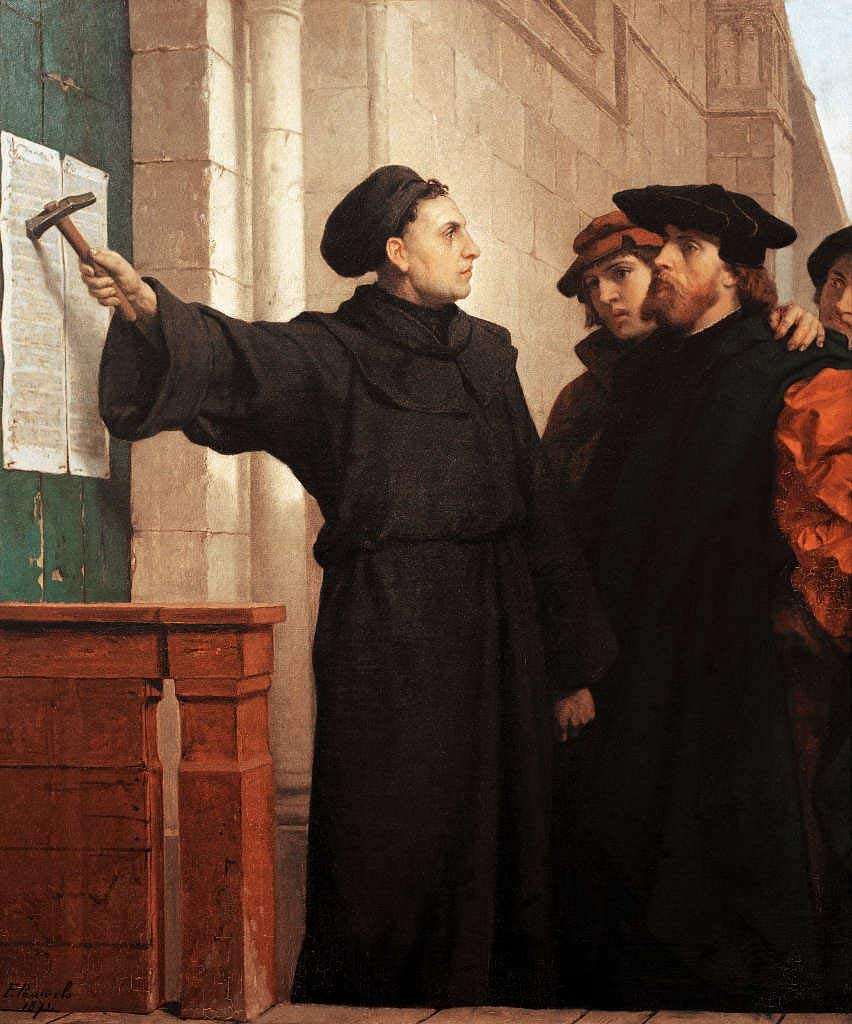
One thing you particularly pressed me on was humility, against my arrogance. You say that my failure to listen to my former church pastors, and to others who disagree with my current theology, is “arrogant.” You especially identify as “arrogant” my willingness to challenge the church. Unfortunately in this case, to quote The Princess Bride, “I don’t think that word means what you think it means.” To you, to appropriately humble myself would be to crawl back to my old theology and my former pastors and admit my self-deception. That kind of position implies that one can never, ever, ever repent from bad theology taught by one’s church. I absolutely reject that notion. It would imply, for example, that Martin Luther was arrogant and absolutely wrong to challenge his church on some very specific failures. And yet, the great Luther, to whom we Protestants owe our independence from the Catholic Church today, started those 95 Theses off with these three:
- When our Lord and Master Jesus Christ said, “Repent” (Mt 4:17), he willed the entire life of believers to be one of repentance.
- This word cannot be understood as referring to the sacrament of penance, that is, confession and satisfaction, as administered by the clergy.
- Yet it does not mean solely inner repentance; such inner repentance is worthless unless it produces various outward mortification of the flesh.
He went on to confront the church on its error. I find that instructive: first, that he was explicitly focused on repentance being more than just saying a prayer in front of a priest, and especially paying for forgiveness; second, that it was a whole-life endeavor; third, and critically, that he was willing to confront an entire theology with what he saw wrong with it. I will not call Luther arrogant. And I reject being called arrogant for similarly identifying failures in the theology I was raised to believe, or standing utterly confident in my understanding, or refusing to recant. If, like Luther, I find myself outcast from what is considered orthodox Christianity, so be it. I consider that the price of following the Holy Spirit.
In saying that, I’m well aware that you can rightly observe that many thousands of Jesus-loving churches teach essentially what you believe. You think that gives your position credibility. It does. But it doesn’t validate that your doctrine is more right than mine. It simply means that yours is founded on various doctrines that empire favored 1,700 years ago, brutally killing those who believed differently, and burning nearly all of their books. As the saying goes, “might does not make right.” It simply silences the alternatives – as did the Catholic Church for centuries, at great cost.
I’m also well aware, since I used to inhabit nearly the same theological space as you, that you consider most of my current doctrine to be absolutely disqualifying, that I’ll be condemned to hell, or at the very least, lose all my reward and be saved “as if through the fire.” That’s precisely how I previously viewed people like I am now. I can’t fix that for you. But I no longer need to. I would only ask this: observe my life. See its fruit. Consider how I treat people, how I serve those around me, whether I am actively living the Way of Jesus.
I anticipate a typical conservative objection: “the works don’t matter if we don’t have the right beliefs about God and Jesus.” I get it, because I used exactly that objection for 40 years when talking dismissively about liberal and mainline Christians. But I respond, in light of James – I will show you my faith by my works. Those works are fundamentally founded in what I believe about the very nature of God, and about Jesus and His instructions and example. It’s explicitly because I believe, that I serve. The church I attend now does far more of the works of Jesus in my community in one year than my former church ever did in many years. I rest in Matthew 25:31-46.
One other thing you raised in your correspondence bears addressing. I’m well aware that my current beliefs, and the process I’ve been through in the last six years, have been disruptive. I left my former church, who could not tolerate someone who didn’t publicly affirm their doctrines. My former friends and family have been dismayed at the change in my theology. Formerly simple relationships have become much more complicated. Especially in a family, where one should not simply walk away, someone suddenly holding sharply different views is definitely disruptive. I get it. One of my own children walked away from my values before I began to reconsider my own theology, and it caused distress for a season. Those who remain naturally wish there were no such difficulties, no reason for dissent, and long for a return to the simplicity of everyone agreeing. But sometimes, it just can’t be so.
I’m not wholly without error here. You rightly challenged me on some of my choices how to address what I’m going through with those who stayed behind, and not finding sufficiently gentle ways of speaking. I accept that rebuke. I submit that behavior to the Lord for refinement; I welcome the chance to mature. But as to my changes in doctrine? I’m sorry, but there’s nothing to repent of. I arrived at this point explicitly by repenting, no matter how you feel about that claim. Whatever disruption may exist from a theological or sociological difference between us is not something I can fix; I would be violating my conscience and my very understanding of the Lord to do that. I’m a new person inside, I’m certain that it’s the Lord’s place for me, and I am pretty sure that the old me just won’t be coming back. You and I will simply have to forge a new relationship on new terms.
To summarize: I stand in exactly zero confidence in myself or my own beliefs to save me – but high confidence that what I believe today is the far better way to read the Bible than what I inherited. More than that, I stand in absolute confidence in God to keep me and preserve me – even if I turn out to be wrong. In the concepts presented in Gregory of Nyssa’s book “The Life of Moses,” we approach God and find ourselves entering deeper and deeper into a luminous darkness, where the closer we get to God, the darker it gets, and so the less we know, because no amount of knowledge can approach the infinity that is God. None of us can be meaningfully right in our beliefs, in light of God’s infinity. All my knowledge is but dust. But I can trust God’s infinite goodness. And I fully trust that what Jesus did on the cross has fully atoned for me, and I remain deeply and intentionally submitted to God.
Thank you for your concern for my soul. It speaks to the love of a brother or sister, and I treasure it.
So that’s my response. I hope it’s been useful to you, also. Be blessed, and we’ll talk again soon.
 and
and  or join our email notification list.